There has been a steady increase in construction, mining, and demolition projects in the UK.
For instance, there has been a 1.1% increase in the output of construction projects in the second quarter of 2025. One of the most common forms of equipment you can find in such projects is forklifts and cranes.
These lifts are operated by trained operators under the supervision of a trained professional or a lift supervisor. These supervisors play an important role in these projects and need to have passed a lift supervisor course as per current regulations.
If you have been considering opting for this role, but don’t know which course to go for, then continue reading below.
What Are the Types of Lift Supervisor Courses in the UK?
The different types of courses for lift supervisors in the UK include:
- CPCS Lift Supervisor (A62) Course
- NPORS 405 Lift Supervisor Course
- LEEA Accredited Training Course
Each of these courses aligns with the CPCS (Construction Plant Competence Scheme) or NPORS (National Plant Operators Registration Scheme). This is applicable even if you go for a fork lift truck training course.
CPCS Lift Supervisor (A62) Course
The CPCS A62 course for lift supervisors is considered the industry-standard qualification for most UK construction sites. You should have passed a CITB*-approved Health, Safety and Environment Test for Supervisors or SPEC SUP within the last 2 years to qualify for this course.
*The CITB is the Construction Industry Training Board, which is responsible for conducting training sessions to churn out skilled industry professionals. *
You should not take this test within less than 2 years of booking this course. Another requirement is that you should also have sufficient knowledge of the usage of cranes as per BS 7121.
The instructors might ask you to demonstrate your knowledge through a form. Finally, you should also have sufficient knowledge of written and spoken English.
The course will take place over 4 days, wherein 3 days will be devoted to theoretical and practical exercises.
During the course, you will learn about the different types of cranes, how to stabilise them, and how to read load-bearing charts. You will also learn your responsibilities as a supervisor, safe work procedures, crane documentation and how to set up exclusion zones.
The last day will involve a series of CPCS technical tests, which will test the knowledge passed on to you.
You will receive a CPCS Trained Operator Card once you pass the CPCS technical tests. The CITB National Construction College e-certificate will be available on request.
NPORS 405 Lift Supervisor Course
The NPORS 405 lift supervisor course is an alternative to the CPCS A62 course. This test is also recognised across the UK. You should have passed a CITB*-approved Health, Safety, and Environment Test for Supervisors within the last 2 years to qualify for this course.
This course is applicable to operators who are new to supervising lifting operations.
You will learn a variety of things in this course, such as the guidelines under LOLER, PUWER, BS 7121, and HSE. The course will also teach you the dangers of working in the industry and your roles and responsibilities.
Consider the table below to learn about the other things the course will teach you.
| Skill | What You’ll Learn |
| Locating and identifying crane equipment | Detailed insights into the different types of lifting equipment, as well as the importance of locating and identifying them. |
| Documentation | How to interpret the various documentation-related reports to derive coherent information |
| Communication | The communication protocols followed during various lifting processes |
| Anti-collision systems | Their purpose, function, and usage |
| Full operation cycle | How to set up, erect, level, and dismantle various lifting equipment |
| Emergency protocols | Setting up exclusion zones and the measures to be taken during emergencies. |
| Hazard identification | Identifying potential hazards associated with lifting procedures |
| Equipment security inspection | Checking how secure the various lifting accessories and equipment are prior to the operation |
| Environmental procedures | Understanding how the area of the operation can impact the lifting operation |
| Out-of-service and securing procedures | How to take equipment out of service and secure it when not in use to prevent unwanted accidents |
Table 1: NPORS 405 Course Inclusions
This course takes place over 1-3 days, depending on whether you’re a novice, an experienced worker, or retaking the course. You will receive an NPORS Accredited Training Course or Plant and Safety Certified qualification after completing the course.
LEEA Crane/Lift Supervisor Course
The LEEA stands for the Lifting Equipment Engineers Association. Their lift supervisor course extends over a period of 3 to 5 days and is ideal for people with little to no experience of supervisory operations.
Whether you are opting for the fork lift truck training or the lift supervisor course, take a look at the table below to learn about the various inclusions.
| Skill | What You’ll Learn |
| Legal requirements | The legal aspects of handling, maintaining, examining, documenting, and recording cranes |
| Staff responsibilities | The roles of each member of the construction staff during a lifting operation |
| Detailed explanation | A detailed explanation about the different types of lifting equipment, and cranes, including their components, controls, systems, and safety devices |
| Pre-operational checks | How to inspect the equipment prior to using them in the field by following the manufacturer’s instructions |
| Site surveys | How to survey the site, inspect it thoroughly, and identify potential hazards before the operation |
| Crane site load placement | Where and how to set up the crane to ensure that no mishaps take place during operation, and also how to maintain the crane’s optimal load-bearing capacity |
| Load assessment | Analyzing the types of loads to be lifted through load charts and determining the types of cranes to be used based on the same |
| Weather forecasts | Studying the weather carefully to determine how to safely erect the crane prior to lifting operations |
| Communication & signalling | How to communicate with site managers and other personnel to ensure a hassle-free lifting operation Using the correct hand signals for nonverbal communication |
| Equipment maintenance | How to carry out routine inspections and maintain the associated lifting equipment |
| Lift plan briefings | How to properly brief team members about the lift plan |
| Entry and exit route inspection | Determining that the crane can safely enter and exit the operational area |
| Pre-use inspections | Checking whether the crane operator has carried out the crane operators have carried out the pre-operation checks |
| Exclusion zone | Determining the presence of an exclusion zone around the area |
Table 2: LEEA Crane/Lift Supervisor Course Inclusions
You will receive an LEEA Accredited certificate after completing the course.
How to Choose the Right Supervisor Course?
Take a look at the infographic below to understand how to choose the right lift supervisor course:
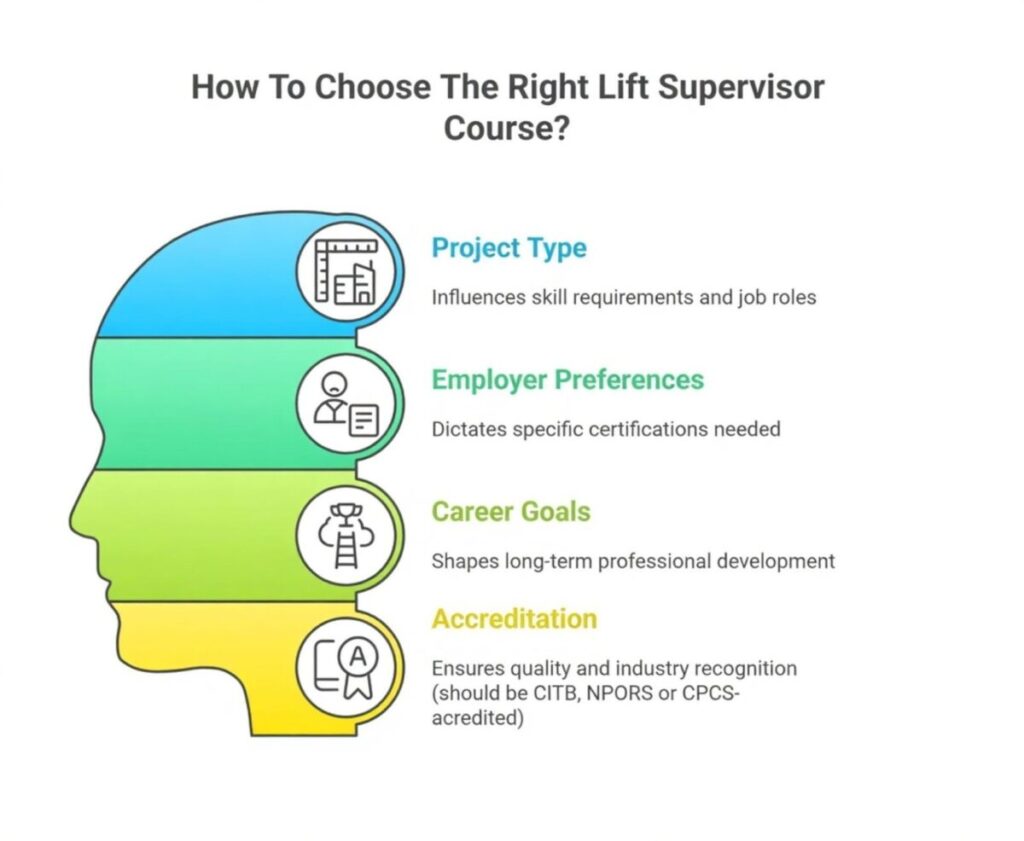
Infographic 1: How To Choose The Right Lift Supervisor Course?
Wrapping Up
Taking a lift supervisor course can help you become a supervisory professional in lifting operations. You should explore each of the course’s demands thoroughly and ensure that it aligns with your long-term goals.
You can also explore additional qualifications like the A40 Slinger/Signaller, the A61 Appointed Person for lifting operations, or fork lift truck training courses. These will help you become a well-rounded professional.