Today, everything is interconnected, and running out of battery feels nearly as bad as misplacing your wallet. Your smartphone, tablet, camera, and laptop serve as both personal and professional necessities—they require a dependable power source. That’s exactly where power banks come in—they are portable and reliable, and they can dramatically extend the operational time of your devices when wall sockets aren’t accessible.
With my background of testing over a hundred products in the last decade, I can confirm that power banks have transformed from clunky bricks to stylish, ultra-thin devices over the years. In this guide, you will find a wealth of information on power banks, including their features and capabilities, how they work, and tips on selecting the most appropriate device depending on individual needs.
What Is a Power Bank In Simple Words?
Storing a power bank’s energy externally enables delivery to multiple devices when needed, acting as a portable battery pack. Charge it at home, power bank will be a perfect companion on wild camping sites or during business trips, providing charge to phones, tablets and laptops.
Unlike older models, today’s offer one and multiple USB ports allowing simultaneous charging of different devices. Compact units fitting in a pocket serve as phone lifers while heavy ones can even power laptops.
The Upbringing Of Oversized Phones To Pocket-Sized Chargers
Alongside greatly evolving portable devices, the era of mobile gadgets and power banks surged in 1973 when Martin Cooper used the first mobile around a gram and worth thirty bucks, later introducing an oversized charger weighing nearly a kilo with only thirty minutes of use. Paradoxical to his invention, a colossal phone was bound to hit the market. Goodenough was on the track to earn the nobel prize, so designed a lithium-ion battery in 1980.
The development of portable mobile phones during the early 2000s added user convenience along with the need for portable chargers. Initially, power banks were poorly designed and non-efficient. Thankfully, the advancements in battery technology allows us to take advantage of small, easy-to-carry, compact, and fast charging power banks that seamlessly fit into our lives.
How Power Banks Operate
Power banks operate on the principles of storing energy in lithium-ion or lithium-polymer cells. The power is charged through USB ports and wall outlets. While on the go, users can easily access their devices by plugging them into a power bank whenever they run low on battery. Devices power needs are managed tumblers so power flow is self regulated enabling seamless usage.
In modern power banks, additional safety mechanisms have been added to avert potential hazards such as overcharge or over temperature protections, protecting against short circuits, and controlling temperature.
Batteries contained in Power Banks
There are two principal types of powers used in power banks:
Lithium ion: Characterized by their lower cost and commonly used due to the high enery density, these batteries are indeed efficient. Their only downside is susceptibility to extreme weather changes.
Lithium polymer: Compared to Li-ion, these are more expensive, but better suited for slim and lightweight designs. They are less prone to leakage and flexible with their design.
Diverse Classes of Power Banks
The various models of power banks available today include:
- Standard Power Banks – Models used to load smartphones and tablets. The ordinary capacity is between 5,000mAh to 20,000mAh.
- High-capacity Models – Ranges from 20,000mAh and above. Suitable for traveling, campers or people who wish to load multiple devices several times.
- Fast charging Power Banks – Support technologies such as Quick Charge or Power Delivery (PD) reducing the time required to charge.
- Wireless Power Banks – This provides Qi-standard wireless charging enabling the charging of devices by placing them on top without using cables..
- Solar Power Banks – Recommended for those venturing out due to availability of solar panels.
- Ultra-compact Models – Extremely small power banks shaped like a lipstick or credit card which are effortlessly portable and allow people to carry them in case of an emergency.
Key Elements To Bear In Mind Before Purchase
Capacity (mAh)
This defines how much charge the power bank can store and is measured in ‘milli-ampere hour’. Usually, a 10,000mAh gives around two or three transports of a phone. While estimating, always include a 20 percent energy transfer loss.
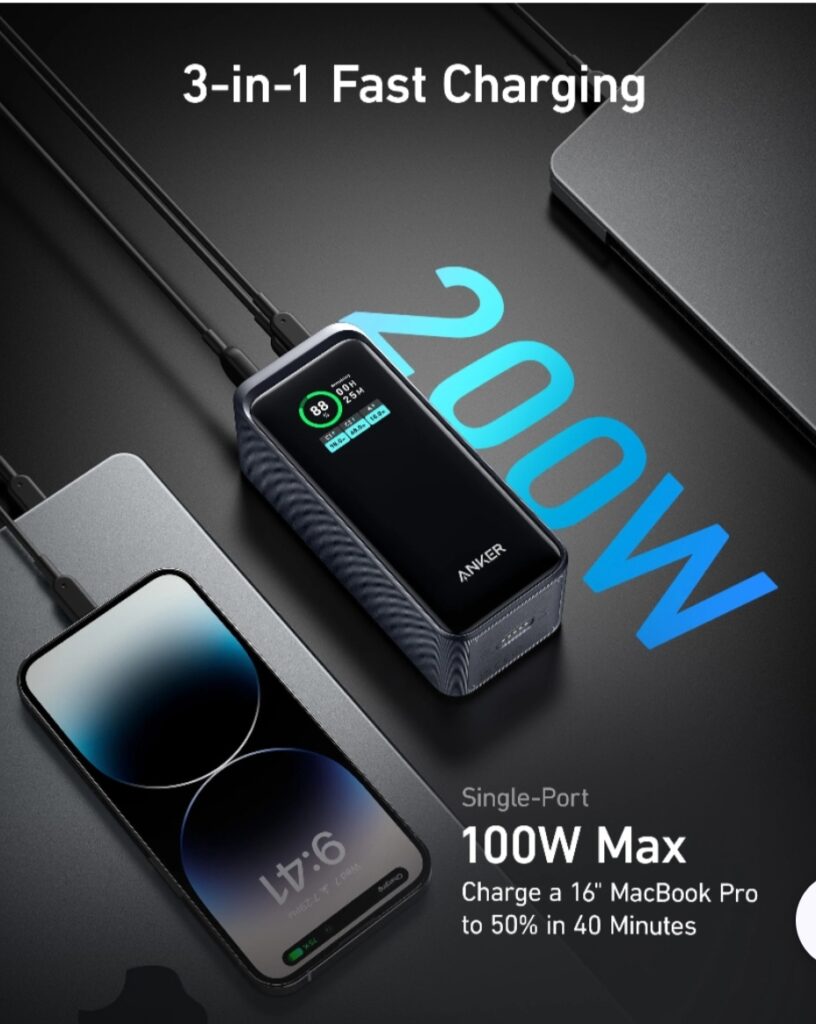
Charging speed
The power bank needs to charge itself and the device needs to be charged. Fast input and output is crucial, protocols such as Power Delivery (USB C) or Quick Charge aid in this regard.
Size and Portability
Deciding if one would sacrifice dimension, mass, and weight for extended battery life.
Number of Ports
- Additional ports allow for the charging of several devices simultaneously. Some advanced models even have AC outlets for laptops.
Pass-Through Charging
- An example of a convenient feature allows you to charge the power bank and your device at the same time— ideal for overnight setups.
Safety Features
- Double check the power bank to ensure it has protection against short-circuiting, temperature control, and overcharging. Safety Features give additional trust if the device is certified with certifications from UL, CE, or FCC.
My Experience: Why Power Banks Are a Very Helpful Invention
Currently, I have a wireless charger which doubles as a power bank for my laptop and is 20,000mAh strong. This is far different from my first power bank, which was purely a 5,000mAh brick. It could only charge my phone once, and also happened to weigh the same as a brick.
While on a multi day hiking trip in the middle of nowhere, my solar-powered bank was able to effortlessly power my phone, camera, and GPS. I had no access to wall sockets nor power sources, but my powerbank performed effortlessly no matter what the weather was and it dated how resilient brackets have become.
Faqs
How long does it take to recharge a power bank?
A power bank charging takes time according to the input power and capacity. For example, a 20,000mAh unit would charge in approximately 8 to 10 hours with a standard 2A charger.
Can I charge devices while the power bank is charging?
As long as the power bank supports pass-through charging, it is possible, but it does produce more heat.
How long do power banks last?
Around 300 to 500 full charge cycles, which translates to roughly 2 to 3 years with regular use.
Are cheap power banks safe?
As long as you stick to reputable brands and check for some certifications, you should be good. Avoid unbranded suspiciously cheap models because they are not trustworthy.
Conclusion
Power banks have become essential to mobile users. Having a quality power bank helps you to stay connected anywhere and in any situation, be it traveling, working outside for long hours, or even enjoying outdoors.
More exciting innovations are in the works focusing on compact designs, fast charging, and smart energy solutions that will enhance these portable chargers even more in the future, so you can expect those as technology advances.